
The growing interest in CJC-1295 No DAC + Ipamorelin reflects the broader scientific interest in combined growth hormone-related peptide signalling.
Researchers investigate combinations of growth hormone-releasing hormone analogues and growth hormone secretagogues to better understand how different endocrine signalling pathways may interact under controlled laboratory conditions.
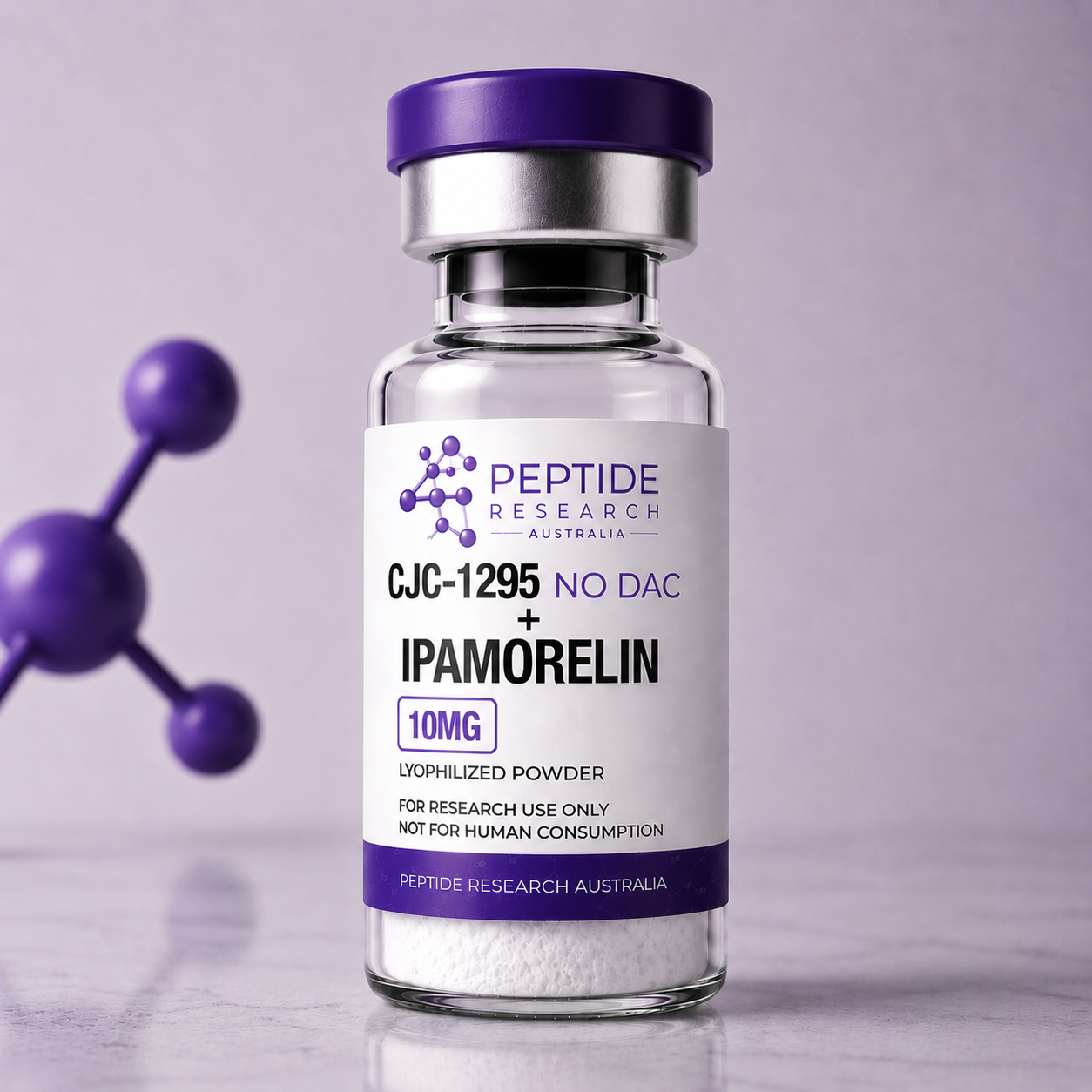
At Peptide Research Australia, CJC-1295 No DAC + Ipamorelin 10mg is supplied strictly for laboratory and scientific research.
Understanding CJC-1295 No DAC
CJC-1295 is a synthetic analogue related to growth hormone-releasing hormone, commonly abbreviated as GHRH.
The No DAC format does not include the Drug Affinity Complex used in some other CJC-1295 research formulations.
Laboratory investigations involving CJC-1295 may examine areas such as:
- GHRH receptor signalling
- Endocrine communication
- Growth hormone regulation
- Hormone pulsatility
- IGF-1 related signalling pathways
Understanding Ipamorelin
Ipamorelin belongs to the growth hormone secretagogue peptide family.
In laboratory research, Ipamorelin is commonly investigated in relation to the growth hormone secretagogue receptor, also known as GHS-R1a or the ghrelin receptor.
Research areas involving Ipamorelin may include:
- Growth hormone signalling
- Endocrine physiology
- Receptor biology
- Metabolic signalling
- Cellular communication
Why Researchers Study the CJC-1295 No DAC + Ipamorelin Blend
Scientific interest in the combination comes from the fact that the two peptides are investigated through different signalling pathways.
| Peptide | Primary Research Target | Research Focus |
|---|---|---|
| CJC-1295 No DAC | GHRH receptor | Growth hormone-releasing hormone signalling |
| Ipamorelin | GHS-R1a receptor | Growth hormone secretagogue signalling |
Researchers may investigate the combination to better understand how these distinct signalling mechanisms interact within controlled endocrine models.
These investigations should not be interpreted as evidence of approved therapeutic or clinical use.
How the Combined Research Model Is Studied
Although the two peptides are investigated independently, researchers may examine them together because they are associated with separate receptor systems involved in growth hormone-related signalling.
| Research Stage | Laboratory Focus |
|---|---|
| CJC-1295 No DAC pathway | GHRH receptor signalling is evaluated |
| Ipamorelin pathway | GHS-R1a signalling is investigated |
| Combined signalling model | Researchers observe interactions between pathways |
| Experimental analysis | Relevant laboratory data is recorded and evaluated |
Current Research Areas
CJC-1295 No DAC + Ipamorelin remains an area of interest across several laboratory research fields.
Endocrine Physiology
Researchers may investigate:
- Growth hormone-related signalling
- Hormonal feedback mechanisms
- Pituitary signalling
- Endocrine communication
Metabolic Research
Laboratory studies may also examine associations between growth hormone-related signalling and areas such as:
- Energy metabolism
- Protein metabolism
- Lipid metabolism
- Cellular energy balance
Cellular Biology
Research may explore:
- Cell signalling pathways
- Growth-factor signalling
- Receptor interactions
- Molecular communication
What Does the Current Research Landscape Look Like?
Research relating to CJC-1295 and Ipamorelin includes laboratory investigations and studies examining the individual peptides.
Research specifically focused on the combined blend is more limited than research examining the peptides separately.
| Research Area | General Research Status |
|---|---|
| Laboratory studies | Available |
| Animal research involving individual peptides | Available |
| Human investigations involving individual peptides | Limited research exists |
| Research on the combined blend | More limited |
| Approved therapeutic use in Australia | None |
Further research is required to better characterise the biological interactions between these peptides in combined experimental models.
Why Research Material Quality Matters
Reliable laboratory research depends on consistent materials and appropriate documentation.
Researchers evaluating peptide suppliers may consider:
- Product purity specifications
- Batch consistency
- Secure packaging
- Clear product identification
- Transparent product information
- Responsive customer support
Consistent laboratory materials can help support better controlled and more reproducible experimental workflows.
Choosing an Australian Research Supplier
Australian laboratories may prefer domestic suppliers for practical procurement reasons.
Transparent Product Information
Researchers should look for clear information regarding:
- Product identity
- Quantity supplied
- Storage guidance
- Research-use designation
- Relevant handling information
Reliable Australian Shipping
Domestic supply can provide advantages such as:
- Shorter transit times
- Reduced international customs exposure
- Easier shipment tracking
- Local customer support
Australian vs Overseas Research Suppliers
| Feature | Australian Supplier | Overseas Supplier |
|---|---|---|
| Shipping | Domestic delivery | International transit |
| Customer support | Local business hours | Possible time-zone differences |
| Communication | Generally easier locally | May involve delays |
| Customs | Not applicable to domestic orders | May apply |
| Procurement | Typically simpler domestically | May involve additional import considerations |
Best Practices for Peptide Research
Researchers working with peptide blends can support more consistent laboratory workflows by following structured procedures.
Why Choose Peptide Research Australia?
Peptide Research Australia is built around a research-focused approach to product supply.
Our focus includes:
- Research-use-only product positioning
- Professional product presentation
- Clear product information
- Australian-based support
- Domestic Australian shipping
- Straightforward online ordering
Explore CJC-1295 No DAC + Ipamorelin 10mg
Browse Peptide Research Australia’s research-focused range and view CJC-1295 No DAC + Ipamorelin 10mg supplied for laboratory and scientific investigation.
Browse Research ProductsFuture Directions in Combined Peptide Research
Scientific interest in combined peptide signalling continues as researchers investigate increasingly complex endocrine pathways.
Future research may continue exploring areas such as:
- Hormone pulsatility
- Hormonal feedback regulation
- IGF-1 related signalling
- Receptor interactions
- Metabolic physiology
- Combined peptide signalling models
As new laboratory evidence emerges, researchers may gain a clearer understanding of how these signalling systems interact under controlled experimental conditions.
Conclusion
CJC-1295 No DAC + Ipamorelin continues to attract scientific interest because the two peptides are associated with different signalling pathways involved in growth hormone-related endocrine research.
While the individual peptides have been investigated in a range of research settings, evidence specifically examining the combined blend remains more limited and further study is required.
For Australian laboratories seeking research-focused products, Peptide Research Australia supplies CJC-1295 No DAC + Ipamorelin 10mg with clear Research Use Only positioning and domestic Australian support.
Frequently Asked Questions
What is CJC-1295 No DAC + Ipamorelin 10mg?
It is a research blend containing CJC-1295 No DAC and Ipamorelin, supplied in a 10mg presentation for laboratory and scientific investigation.
Why are CJC-1295 No DAC and Ipamorelin studied together?
Researchers may investigate the combination because the peptides are associated with different receptor pathways involved in growth hormone-related endocrine signalling.
Is the CJC-1295 No DAC + Ipamorelin blend approved for therapeutic use in Australia?
No. The product is supplied for laboratory and scientific research only and is not approved for therapeutic or clinical use.
Why does peptide quality matter in laboratory research?
Consistent product quality, clear identification, appropriate packaging and documentation can help support controlled and reproducible laboratory workflows.
Is CJC-1295 No DAC + Ipamorelin intended for human use?
No. Products supplied by Peptide Research Australia are intended for laboratory and scientific research only and are not intended for human or veterinary use.